
Branding a Nation: How Trade Marks Shaped Australian Culture (1900–2026)

Trade marks are far more than legal tools. In Australia, they have become cultural touchstones; symbols that capture who we are, what we value and how we see ourselves as a nation. From the pantry staples that defined early Australian households to the global tech innovators reshaping our digital future, trade marks tell the story of Australia’s evolution over more than a century.
The influence of trade marks extends into the way Australians construct and express identity. Marketing and consumer‑behaviour research has long recognised that people use brands as a form of self‑expression, a way to signal personal values, lifestyle and aspirations.[1] At the same time, brands help shape social identity by reflecting the norms, humour and shared experiences of a community.[2] Australian brands have excelled at doing both.
Think of RM Williams, a brand that has become shorthand for rugged independence and craftsmanship, a personal identity statement for many Australians. Or Vegemite, whose trade mark has transcended the product itself to become a symbol of national pride and cultural in‑jokes. Surf brands like Billabong and Rip Curl have helped define Australia’s global image as relaxed and connected to an outdoor coastal lifestyle, while newer brands such as Who Gives A Crap tap into a growing social identity around sustainability and ethical consumption. These brands resonate because they reflect both who Australians believe themselves to be and the communities they feel part of.
This dual role, shaping personal identity and reinforcing social belonging, is why trade marks influence culture in subtle but powerful ways. They shape our language, our humour, our habits and even our national identity. The brands that evoke childhood nostalgia, the logos that instantly signal trust, the slogans that become part of everyday conversation, these are more than marketing successes. They are cultural anchors that connect generations and help Australians articulate who they are.
For businesses, understanding this cultural influence is more than an academic exercise, it’s a strategic advantage.[3] A strong trade mark doesn’t just protect a name or logo; it builds recognition, loyalty and emotional connection. It gives companies the legal foundation to grow, the credibility to compete and the ability to stand out in a crowded marketplace. In a world where consumers gravitate toward brands that feel authentic and meaningful,[4] and reflect both personal identity and shared social values,[5] a well‑crafted and well‑protected trade mark is one of the most valuable assets a business can own.
This four‑part series explores how Australian trade marks have evolved from the early 1900s to today, highlighting the brands that shaped our culture and the lessons modern businesses can draw from them. By understanding the history behind Australia’s most iconic trade marks, companies can better appreciate the power of branding and the importance of securing their own place in Australia’s cultural story.
Part 1: The Birth of Australian Brands (1900s–1940s)
Australia’s early trade marks tell the story of a young nation learning to define itself. In the early 1900s, brands weren’t just commercial identifiers, they were symbols of trust, quality and emerging national pride. As Australia moved from colony to nationhood, these early trade marks played a quiet but influential role in shaping how people understood themselves and the communities they belonged to. They offered familiar symbols in a period of social change, helping Australians make sense of a new national identity through the products they used every day. This era is marked by a number of defining trade marks that became woven into daily routines and cultural life, reflecting the values, aspirations and emerging confidence of a young nation.
Arnott’s
Arnott’s, with its iconic parrot logo, became one of the first widely recognised Australian trade marks, embedding itself in family kitchens and shaping the rituals of home life. Its rise reflected the culture of early 20th‑century Australia, a period defined by domestic stability, community connection and a growing preference for locally made goods. As the nation was still forging its identity, Arnott’s came to symbolise reliability, quality and the emerging pride in Australian manufacturing, a reputation reinforced by its early marketing and widespread distribution across regional and urban Australia (Arnott’s Biscuits Ltd; National Museum of Australia).

Photo credit: IP Australia
Bushells Tea
In the early 1900s, tea drinking was far more than a simple beverage choice; it was a daily ritual that brought Australians together in homes, workplaces and community halls. Bushells tapped into this growing culture of connection, becoming synonymous with hospitality, conversation and the community spirit that shaped early Australian life. Its trade mark reflected a society that valued warmth, neighbourliness and the simple act of sharing a moment with others, qualities that historians note were central to community life in the Federation era (National Museum of Australia; State Library of NSW). Through its widespread presence and accessible branding, Bushells helped embed the “cuppa” as a defining social ritual, reinforcing the idea that everyday products could play a meaningful role in shaping national identity.

Photo credit: Archive.org
Qantas
When Qantas introduced the flying kangaroo in 1920, it captured the imagination of a country beginning to look outward. Aviation represented innovation, ambition and the promise of connection across vast distances (National Museum of Australia; Qantas Heritage Collection). The kangaroo emblem became a defining feature of Qantas’ postwar identity,[6] capturing the spirit of a nation that was increasingly proud, outward‑looking and confident on the global stage. More than a corporate mark, the flying kangaroo evolved into a cultural symbol, representing Australia’s resilience, its instinct for exploration and the distinctive character that set the nation apart. Historians and cultural commentators note that Qantas played a pivotal role in shaping Australia’s international identity, with its trade mark becoming one of the most recognisable symbols of the nation both at home and abroad (Qantas Heritage Collection; Australian National Archives).

Photo credit: IPR Online
Vegemite
When Vegemite launched in 1923, it quickly became a uniquely Australian flavour and a powerful marker of national identity. At a time when Australia was seeking to distinguish itself culturally from Britain, Vegemite offered something unmistakably local, distinctive and unapologetically different. During the Second World War, rationing meant many Australians could not purchase Vegemite freely, yet its allocation to the armed forces reinforced the idea that it was essential to the nation’s wellbeing. Supplying Vegemite to troops became a symbol of patriotism,[7] strengthening its association with Australian resilience and unity. Its trade mark soon became tied to childhood, family breakfasts and the shared nostalgia that binds generations.[8]
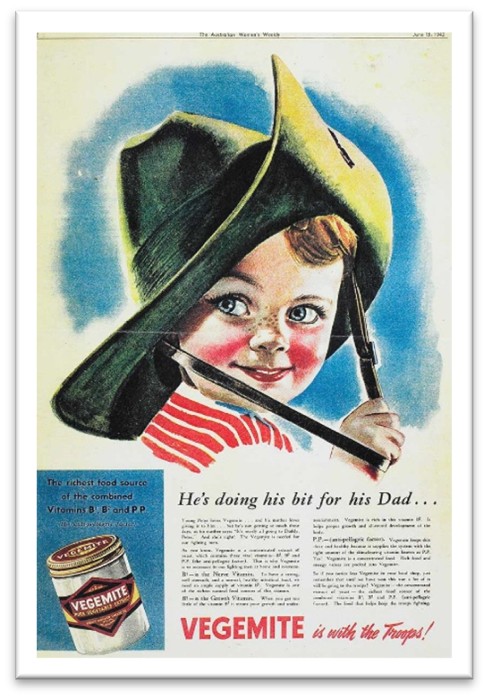
Photo credit: nma.gov.au
R.M. Williams
R.M. Williams emerged during the Depression era, a time when resilience, resourcefulness and craftsmanship were essential to daily life in rural Australia. The brand’s trade mark reflected the rugged, hardworking spirit of the outback, a culture built on endurance, self‑reliance and deep connection to the land.[9] What began as practical footwear for stockmen quickly evolved into a national symbol of authenticity and Australian grit.
Photo credit: RM Williams site
Aeroplane Jelly
Introduced in 1930, Aeroplane Jelly became a beloved symbol of optimism during the hardships of the Depression. Its cheerful branding and the now‑iconic “Aeroplane Jelly Song” offered Australians a sense of lightness and joy at a time when escapism and simple pleasures were deeply valued. It became the soundtrack of Australian childhoods, the jingle and branding reinforcing the idea that even small, everyday treats could help build a sense of national togetherness and collective resilience.
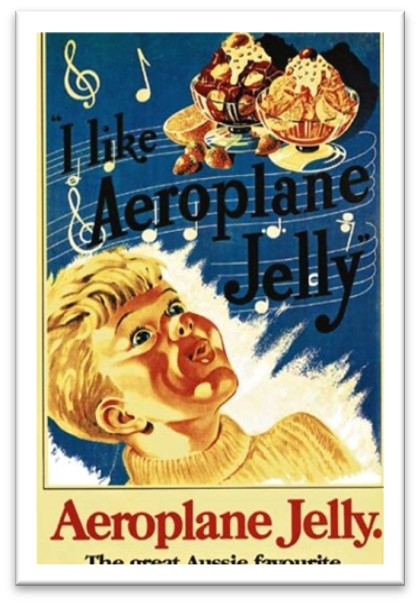
Photo credit: smh.com.au
Part 1 Conclusion
These early trade marks did more than sell products, they helped Australians see their own stories reflected in the brands they used every day. They captured the qualities that would come to define the national character: practicality, resilience, humour and a proudly homegrown spirit. In doing so, they laid the foundations for a distinct Australian identity, one that continues to influence how brands resonate with consumers today.
In Part 2 of this series, this legacy becomes even clearer. As Australia entered the post‑war era, trade marks evolved alongside a society that was becoming more urban, more diverse and increasingly connected to global culture. Brands no longer simply reflected who Australians were, they began shaping who Australians aspired to be. The next generation of trade marks reveals how companies responded to shifting values, new technologies and a rapidly modernising nation, marking a transition from symbols of domestic life to icons of national ambition and international presence.
Footnotes
[1] Russell W Belk (1988). “Possessions and the Extended Self”, The Journal of Consumer Research, Vol 15, No 2, pp. 139-168; Jennfier L Aaker (1997). “Dimensions of Brand Personality”, Journal of Marketing Research, Vol 34, No 3, pp 347-356; Strizhakova Y., Coulter, R.A. And Price L.L. (2008). “The meanings of branded products: A cross-national scale development and meaning assessment”, International Journal of Research in Marketing. 25(2), 82-93; Strizhakova Y., Coulter, R.A. And Price L.L. (2011). “Branding in a global marketplace: The mediating effects of quality and self-identity brand signals”, International Journal of Research in Marketing. 28 (4), 342-351; Munteanu Claudiu Cătălin and Pagalea Andreea (2014). “Brands as a Mean of Consumer Self-expressions and Desired Personal Lifestyle”, Procedia – Social and Behavioural Sciences, Vol 109, pp 103-107.
[2] Douglas B. Holt (2004). How Brands Become Icons: The Principles of Cultural Branding, Harvard Business Review Press.
[3] Ibid.
[4] Michael B. Beverland (2005). “Crafting Brand Authenticity: The Case of Luxury Wines”, Journal of Management Studies, 42:5, 1003-1030.
[5] Douglas B. Holt (2004). How Brands Become Icons: The Principles of Cultural Branding, Harvard Business Review Press.
[6] Qantas Heritage Collection https://www.qantas.com/en-au/about-us/history. [Accessed 8 February 2026].
[7] Hannah Viney (2023). “100 Years of Vegemite, the wartime spread that became an Aussie Icon”, Australian Geographic Online https://www.australiangeographic.com.au/history-culture/2023/07/a-rose-in-every-cheek-100-years-of-vegemite-the-wartime-spread-that-became-an-aussie-icon/ [ Accessed 8 February 2026].
[8] Barbara Santich (2012). Bold Palates: Australia’s Gastronomic Heritage, Wakefield Press.
[9] David Prestipino (2024). “Aussie Icon R.M. Williams celebrates a century of Indigenous ties”, National Indigenous Times Online, https://nit.com.au/21-10-2024/14386/aussie-icon-rm-williams-celebrates-a-century-of-indigenous-ties [Accessed 8 February 2026]; .