
Personal Brands in the Age of AI: The Growing Importance of Trade Mark Protection
Published 1 July 2026

Taylor Swift and Matthew McConaughey Turn to Trade Mark law in the Fight Against AI Impersonation
In an age where AI generated images, video, and audio are becoming indistinguishable from legitimate ones, celebrities are getting creative to try and prevent wrongdoers from misusing their image via AI. Matthew McConaughey and Taylor Swift have each recently turned to use trade mark law in a quite unusual way: to formally protect their very identities.
Matthew McConaughey
Matthew McConaughey’s recent U.S. trade mark filings are a prime example of an actor’s efforts to protect their likeness from AI misuse, including unauthorised AI cloning and deepfakes, via the trade mark system. McConaughey has filed for several trade marks, including sound marks that capture his iconic delivery of the Dazed and Confused lines-turned-catchphrases “Alright, alright, alright” and “Just keep livin’, right?” as well as motion marks of himself looking directly to camera in front of a fireplace and Christmas tree and making casual motions outdoors.
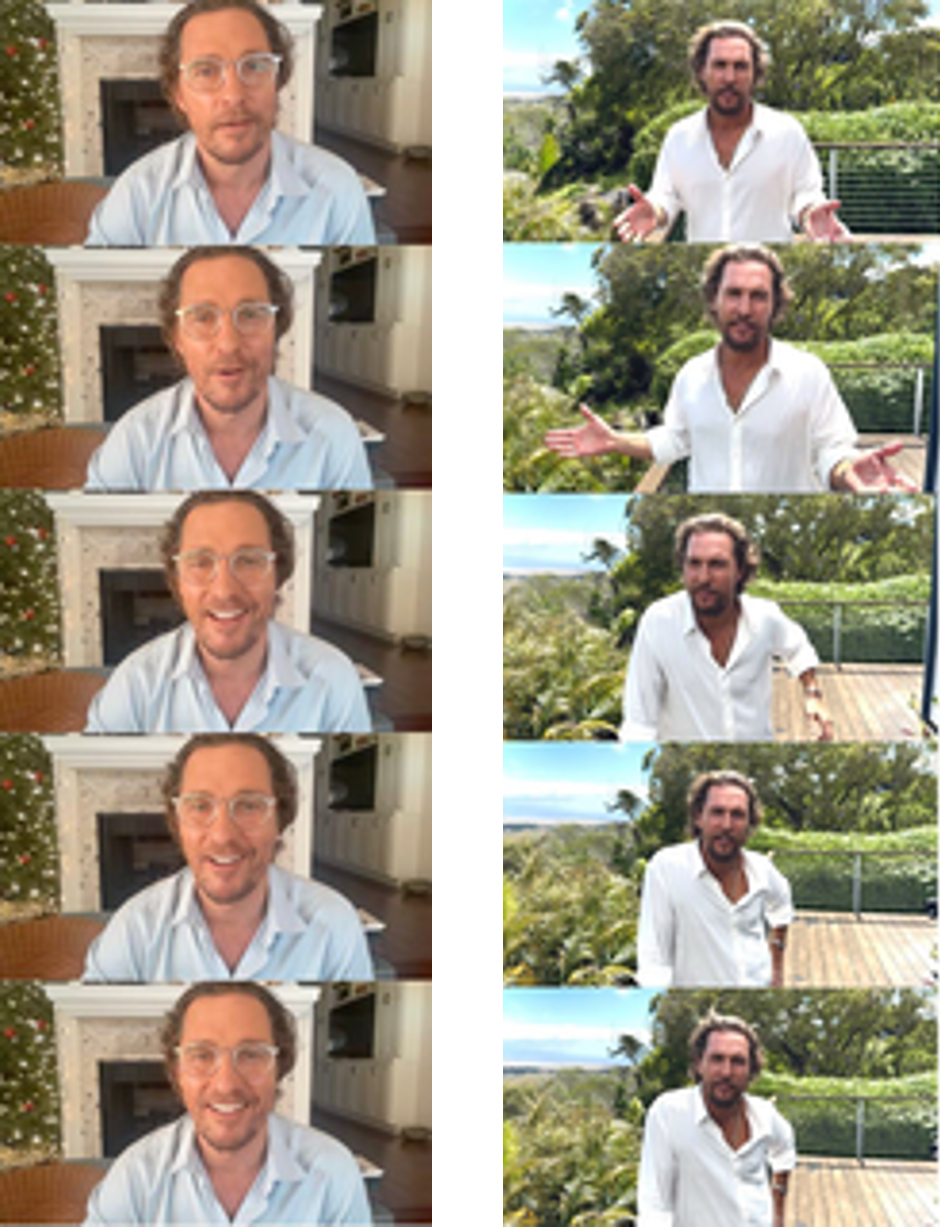
Photo credit: Trade Mark References 98328106 and 98299749
Each of these trade mark applications have been accepted for registration by the USPTO.
McConaughey and his team have made the reasoning for these filings clear, stating that he wants any use of his voice and likeness to occur only with express consent.
Taylor Swift
Tayor Swift is no stranger to the U.S. Trade Marks Office – we have written before about her team’s proficiency in protecting her brand.
Her most recent bid to protect her image is comparable to McConaughey’s, filing three trade marks to protect her voice and likeness. Swift’s team has filed two sound marks, consisting of the singer’s voice saying “Hey, it’s Taylor Swift” and “Hey, it’s Taylor” – common ways for her to begin videos on her social media channels and greet crowds at her concerts. Additionally, a visual mark has been filed that utilises a photograph taken from the Eras Tour – which has become emblematic of the singer’s success. It is described as consisting of “a photograph of Taylor Swift holding a pink guitar, with a black strap and wearing a multi-colored iridescent bodysuit with silver boots. She is standing on a pink stage in front of a multi-colored microphone with purple lights in the background.”
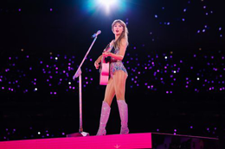
Photo credit: Trade Mark References 99784977
Potential Positives and Drawbacks
There are several positives to support this approach. For one, trade marks are an extremely well-established mechanism for legal enforcement. The trade mark system has been in place for a long time, and very clear boundaries can be drawn when it is utilised properly. As the risk of customer confusion is a key point in trade mark disputes, there could be a strong case in the favour of a celebrity who has trade marked their likeness in a situation where deepfakes are created that appear to show them endorsing a product or company.
But there are some drawbacks and uncertainties.
Trade mark infringement generally requires commercial use of the mark in question, to have a chance of customer confusion. If an AI deepfake is created and shared purely for obvious parody or entertainment value, these registered trade marks may not have power to bring legal action against the creator.
For the same reason, it may be difficult for these celebrities to prove that they have in fact used these particular signs as a trade mark in local commerce. Trade mark rights become vulnerable to non-use cancellations once they have not been used for a number of years, and for this reason the actual strength and enforceability of these types of ‘likeness’ trade marks might turn out to be quite low.
As well as this, trade mark registration is jurisdictional. That means that McConaughey and Swift may struggle to bring action against such misuse by a third party that occurs outside of the United States (the jurisdiction where they have registered these marks – so far).
Last and perhaps most important is that the jurisdictional system simply has not yet quite caught up with the latest technological developments. For example, AI misuse of an artist’s voice can become a real and tangible issue in the entertainment industry, while in the current Australian trade marking system it is not possible to protect the general sound of someone’s voice – this can only be requested for a particular reputable catchphrase. For now, in Australia artists might instead be better off turning to the Australian Consumer Law (Schedule 2, Competition and Consumer Act 2010 (Cth)) or the tort of passing off to try to protect their likeness from AI misuse. These provisions rely largely on the reputation that exists and how, in light of that reputation, another party’s conduct is likely to cause deception or confusion. All circumstances must be taken into account under these provisions, may prove better suited to tackle AI misuse where the law has not yet caught up on recent developments in technology.
What Can We Learn?
While most people do not have a brand associated with their identity, these examples demonstrate how AI is increasingly testing the limits of existing laws and driving the need for creative legal adaptation.
These innovative attempts to protect one’s likeness mark a departure from creatives’ previous attempts to shut down unauthorised use of their image/work by AI platforms, typically using copyright law. More clarity now exists regarding the limits of copyright law against AI misuse (for example, in Australia unauthorised recreations of personal voices by AI models is not captured in copyright law) which has forced creatives to be – well – even more creative when it comes to protecting their identity.
This new strategy reflects the fact that currently, AI is evolving quicker than the law. Celebrities are exploring new avenues to protect themselves and draw boundaries around the use of their image in this new digital age. In essence, this new trade mark strategy is about reinterpreting and testing existing trade mark law to reinforce claim to an artist’s right to consent to the use of their image commercially.
Whether this strategy will catch on or will hold up in court is yet to be seen.
Featured: McConaughey and Swift as depicted in US Trade Marks 98328106 and 99784977
Related reading: Green Branding and “Eco” Trade Marks: IP Risks in Sustainability Claims